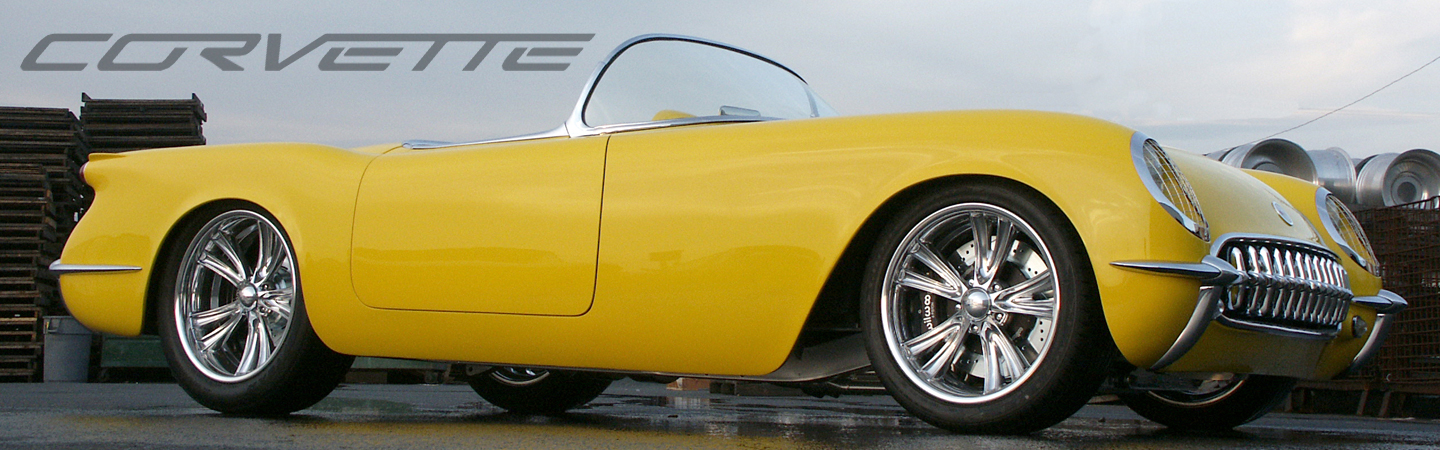
Chevrolet Corvette Brakes
During WWII many U.S. servicemen were stationed in England. While
there, a lot of them got the chance to drive the MG, the Austin Healy, the
Morgan and Jaguar sports cars. These cars were small, light and nimble, and
Americans thought they were fun to drive. After the war, the servicemen
returned home with fond memories of driving the English sports cars. It didn’t
take long before the cars were being imported into the United States, selling
as fast as they could be shipped in.
1960 Chevrolet Corvette
The management at General Motors closely
monitored United States car activity and recognized the interest in these
sporty vehicles. Until then there were no plans to make such a car, but in 1951
chief designer, Harley Earl, the man who invented the concept car, decided to
build an American sports car concept based on a Chevy. He turned the project
over to Robert McLean with instructions to build a small sports car that would
sell for about the same price as a normal sedan. The only way McLean could do
that was to use off-the-shelf Chevy parts, so he took a ‘52 Chevy chassis and
modified it to a smaller, 102-inch wheelbase dimension.
In an effort to improve the car’s handling, the engine and
transmission were pushed back in the chassis so that a 53/47, front-to-rear
weight distribution balance could be achieved. The only Chevy engine available,
a straight six, was outfitted with higher compression, a performance camshaft
design and a tri-power intake manifold. The engine was developing 150
horsepower, which was much better than the four-cylinder engines used in some
of the English cars and comparable to some of the six-cylinder engines used in
others. The only transmission that could hold up to the stronger six-cylinder
engine was the Powerglide automatic transmission.
With input from Earl, stylists were developing a smooth and showy
body design. Instead of looking like a British car, this sports car would be uniquely
American in design. In fact, the car was so smooth for the time period Chevy
engineers wanted to build the body out of Fiberglass, a new process at the
time. Chief GM engineer, Ed Cole, saw the concept car being developed for the
1953 New York Auto Show and fell in love with the idea. Before the car even
debuted, Cole made sure it would be more than just a concept. A meeting was
called to name the new car and Myron Scott, an assistant advertising manager,
suggested “Corvette,” which is a small, maneuverable warship smaller than a
destroyer but equally lethal. Everyone loved the sound of the name and it was an
appropriate image for the car.
1960 Chevrolet Corvette
The concept car debuted at the New York Auto
Show and was a big success. The body design was awesome compared to the other cars
at the show and a hot sports car was very desirable. Everyone at the show
wanted to know when they could buy one. A special assembly line was set up, and
the car was released in June 1953. Since the vehicle was introduced toward the
end of the model year, only 300 were produced.
The ‘53 model was only offered in Polo White, but in 1954 the
Corvettes were also offered in, Pennant Blue, Sportsman Red and Black.
Production ramped up in 1954 with 3,640 produced, but the Corvettes weren’t
selling as expected because the Sticker price was $3,498, $1,000 more than the
cost of a loaded Chevy sedan or hardtop, and though great looking, the car’s comfort,
handling and acceleration was not up to expectations.
In 1955 the cars were offered with an optional V8 engine, but
still only 700 were sold that year.
The 1956 Corvette was modified and sales began to increase. It
was updated with a smooth and aggressive looking body style and an optional
removable hard top. Chevy also made advancements in their fiberglass technology,
improving overall quality. Small improvements were made to the chassis and all ‘56
Corvettes were equipped with a 265ci 210 horsepower V8 engine, causing the
car’s acceleration to be far better than that of the six-cylinder.
The Corvettes were now available with a floor-mounted,
three-speed manual shift transmission, making them more fun to drive. The ‘57 model
looked just like the ‘56 but there were substantial engineering changes. It
offered a T-10 four-speed transmission and the engine size increased to 283ci.
Corvette buyers could now select from a 220 horsepower four-barrel engine, a
245 or 270 horsepower dual-quad engine or a 283 horsepower fuel- injected
engine. This was the first really hot year for the car with 6,339 cars sold.
The Corvette body changes in 1958 included dual headlights and
options such as fake hood louvers that were ultimately dropped for the ‘59
model year. The ‘58 Corvette was also equipped with some powerful 283 engines
and included a 230 horsepower base engine, a 250 and 270 horsepower dual-quad
engine and a 290 horsepower fuel injected engine. The Corvettes were increasing
in popularity and in 1958, 9,168 were sold, making it the first year the car was profitable.
The 1958 body design and mechanical offerings carried through
1960 with small trim changes.
1963 Chevrolet Corvette
In 1961 the back of the car was changed from the round
design to one with a ducktail but the big improvement was the new 327ci engine.
The Corvette was offered with several engine options in horsepower ranges
starting with the base 250 horsepower engine. It was also offered with 300, 340
and 360 horsepower with carburetion, and the fuel injection model delivered 375
horsepower, really more than the old ‘52 style chassis was made to handle.
Wilwood Engineering recently
introduced front disc brake kits designed for first generation Corvettes, model
years 1953-1962. These kits fit inside most original 14-inch, steel wheels and provide
substantial weight savings over the original cast iron caliper/rotor set up,
without any of the rust and corrosion issues common to cast iron parts. The Forged
Dynalite Pro-Series Brake Kit, part number 140-11811, features a front hub
kit and 11-inch rotors in slotted or drilled and slotted styles, available in
red or black powder coat. A similar kit, part number
140-11812, is available with 12.19-inch rotors. Wilwood also released rear
brake kits that fit model years, 1957 -1962. The Forged
Dynalite Pro Series with Internal Drum Parking Brake, part number 140-11827,
offers 11-inch rotors in slotted or drilled and slotted styles, available in
red or black powder coat. An
additional rear brake kit, part number
140-11828, features 12.19” rotors in slotted or drilled and slotted styles,
available in red or black powder coat.
Chevy decided to introduce a completely new body and chassis
design in 1963. Marking the 10th anniversary of the Corvette, Bill
Mitchell, with help from Larry Shinoda, designed the new Sting Ray, a vast
departure from the previous models. Zora Arkus Duntov, an engineer who worked
on the Corvette from the beginning, developed a completely new chassis that
featured four-wheel independent suspension for improved handling. The
suspension was also shortened to 98-inches. The ‘63 Corvette also featured fake
grilles on the hood and a split rear window that made them look great, but impeded
vision. Chevy enthusiasts loved the new model and sales really took off, with
10,919 convertibles and 10,594 coupes produced.
The ‘64 Corvette was similar to the ‘63 but the hood vents were
eliminated and the rear window was one piece.
The big change came in 1965 when the chassis received four-wheel
disc brakes and an available 425 horsepower 396ci big-block engine. The ‘66
Corvette was similar to the ‘65, but the
big-block engine size increased to 427ci.
The ‘67 Corvette was the ultimate second generation body style
with new side vents, a 435 horsepower tri-power 427 engine, with a tamer 400
horsepower 427 available. Chevy also offered an L88 427 engine option for the
Corvette that delivered 430 horsepower, with claims up to 500. The 427
Corvettes were distinguished by the “Stinger” hood scoop and 427 emblems.
The ‘63 and ‘64 Corvettes had independent
front suspension but they were still equipped with drum brakes. Seeing a need
for improvement, Wilwood Engineering released a Front Disc Brake
Kit, part number 140-11011, that features a front hub kit and Dynalite calipers.
In 1965 Chevy introduced four-wheel disc brakes on the Corvette, a big
improvement. The brakes were good when they were new but the calipers developed
a problem of rust pitting in the piston bores and then they would start
leaking. Wilwood Engineering became aware of this problem and released a D8-4
caliper that is a direct bolt-on to the original brakes. It features a forged billet aluminum body and
uses stainless steel pistons so there is no chance of leaking. Since the
Corvette used the same calipers from ‘65 to ‘82 this kit will work on both the
second and third generation models. This brake improvement is perfect for
Corvette owners who want to keep the car original in appearance. If originality
is not a factor, Wilwood also makes two big brake kits for Corvettes
: The
Superlite 6R Big Brake Front Brake Kit, part number 140-10616, featuring six-piston
Forged Superlite calipers and 13.06-inch rotors in
slotted
or drilled and slotted styles, available in red or black powder coat. A similar kit,
part number
140-10617, is available with 14-inch rotors. And the
Superlite
4R Big Brake Rear Kit, part number 140-10472, that features four-piston Superlite
calipers in red or black powder coat. This kit features 12.88-inch rotors in a
slotted or drilled and slotted style. A similar kit is also available with
14-inch rotors.
In 1965 Larry Shinoda designed the Mako Shark concept car. The
public loved the futuristic design and it became the foundation for the ‘68
Corvette. The new car had removable tops and a pop-out rear window, turning the
coupe into a style very similar to a convertible but still retaining the
appearance of a coupe. This was the first T-top car and all Corvettes after
this one had removable tops. The engine selections, including the L88, were
carried over to the ‘68 model, but the L88 remained a limited edition engine
option. The ‘68 Corvette had minor problems that were fixed when the ‘69
Corvette was released. Both cars were very similar in appearance and engine
availability.
In 1970 the body had new side grilles and the 427 was replaced
with a 454 engine. The ‘70 model was also introduced with a strong running LT-1
350 engine that featured 370 horsepower and came with solid lifters for a high
rev capability. The ‘70 Corvette was going to be offered with an LS-6 and LS-7
engine option but Chevy never released either one, instead offering a 390
horsepower LS-5 454 engine. The LS-6 engine was used in the Chevelle making it
the first passenger car with a more powerful engine than a Corvette.
1982 Chevrolet Corvette
Throughout the ‘70s, the Corvette received
small body changes and decreased engine power in an effort to comply with
emissions regulations. The ‘75 and newer Corvettes were offered with a base 350
engine and a higher horsepower L82 350 engine. In 1978 the Corvette received a
new tail with a large rear glass, providing more luggage space. Two special
models were also available: the Silver Anniversary and the Indy Pace Car
editions.
Another body change came in 1981 that gave the Corvette a very
aggressive appearance but the power was minimal. In fact, the only engine
available in California was a 305ci small-block. In 1982 Chevy introduced a new
Cross Fire Injected 350ci small-block Chevy engine that met California
emissions regulations.
The ‘82 featured a front air-dam style spoiler, a small rear
spoiler and was available with very nice looking alloy wheels. Another
desirable feature was hinged rear glass that opened for easier luggage loading.
This same year another special edition model became available.
The late introduction, ‘83 Corvette was a drastic departure from
the previous model in design and engineering. It featured an aluminum front and
rear suspension system and a unique chassis design. The front opened up in a
clamshell design, which made engine access easy but repair work expensive if
the car got into an accident.
The Corvette ride and drive press release was held at the
Riverside Raceway in mid-‘83, and the new car was a big hit with the press. During
the presentation a journalist suggested that the car be called an ‘84 instead
of an ‘83. Chevy management executives agreed.
The ‘84 Corvette featured 16-inch wheels running gator back
tires and was outfitted with very positive rack and pinion steering. It also had
a dash display that looked like a video game. The Cross-Fire Injected engine
was equipped with new, high-flow aluminum heads, increasing the engine’s
horsepower to 245. The car also offered a new overdrive automatic transmission
or a five-speed manual transmission. Enthusiasts loved the new model and Chevy sold 53,877 Corvettes.
The ‘85 Corvette was similar to the ‘84 model except the engine
that featured a new Tuned Port Injection system, bumping the horsepower up to
250.
The big change for 1986 was the introduction of a new convertible
model used to pace the Indy 500.
In 1989 the Corvette was outfitted with 17-inch wheels and new
unidirectional tires.
The ‘90 Corvette received a body revision and was now available
with an LT-5 engine option. The Lotus designed, dual overhead cam engine, built
by Mercury Marine, was all aluminum engine and featured 375 horsepower. The
special ZR-1 option also included widened rear fenders that were housing
P315/35ZR17 tires. The Corvette could go from 0-60 in 4.71 seconds and turn the
quarter in 13.3 seconds at 110 mph. The engine was great but the $58,995 price
tag was extremely high for the time period.
In 1991 some changes were made and the horsepower was increased
to 405. The price also jumped to $64,138. Some dealers were adding a premium on
top of that and, in some cases, the price topped out at $100,000.
The LT-5 engine was discontinued in 1995, a year before the new
Corvette was introduced.
Wilwood Engineering introduced a brake
improvement for the 1988 through 1996 Corvettes. The brake kit being offered is
the Superlite
6R Big Brake Front Brake Kit, part number 140-8337, featuring six-piston Forged Superlite
calipers and large 12.88-inch rotors in slotted or drilled and slotted style.
The big calipers are available in red or black powder coat. A similar kit, part number
140-9298, is also offered with large 14-inch rotors. Wilwood offers a rear rotor update for the Corvette, part number
140-8314, that includes the rotors, aluminum adapter plates, brake pads,
braided steel hoses and all necessary hardware to make the change.
The new 1997 Corvette was a big departure from the previous
models. It featured a front mounted engine and a rear mounted transmission to
balance the front to rear weight distribution. The engine options were also
changed to an all aluminum LS-1 that was developing 345 horsepower. This car
also featured 18-inch rear wheels and 17-inch front wheels running unidirectional
tires.
The 1998 Corvette paced the Indy 500 and a special model was
available.
>In 1999 the Corvette received a heads-up display that was
projected on the windshield. A third coupe body style, the Z06, was offered in
addition to the hatchback and convertible. The Z06 coupe featured a new LS-6
engine that was delivering 385 horsepower for the 2001 model and 405 horsepower
for the 2002 model year, matching the (LT-5) horsepower rating.
In 2003 there was a special 50th anniversary edition
made available that featured a deep red color.
In 2005 Chevy engineers wanted to design the ultimate Corvette
that incorporated all the best features of the previous Corvettes, with none of
the problems. It was also a goal to bring the price down to increase sales. The
engineers started by making the car lighter, changing the body design to look
more aggressive and installing a new engine to make the car faster than any of
the previous Corvettes in base form. The model received a new LS-2 engine that
develops 400 horsepower and 400 ft lbs of torque. This is net horsepower not
gross, so today’s Corvette is developing more horsepower than any of the 427s
in the early years. The Corvette also received exposed headlights, the first
since 1962, for a design feature and elimination of the heavy mechanisms
necessary for hideaway headlights.
The new base model Corvette does 0-60 in 4.2 seconds and turns
the quarter in 12.6 seconds at 114 mph. The Z06 Corvette is still available and
the special engine is rated at 505 horsepower. This special edition Z06 can go
from 0-60 in 3.7 seconds and it turns the quarter mile in 11.7 seconds at 125
mph. The top-of-the-line ZR1 Corvette features a supercharger and the engine
produces 638 horsepower. The ZR1 does 0-60 in 3.4 seconds and turns the quarter
mile in 11.3 seconds at 131 mph.
Over the years, the Corvette has earned a reputation for being
one of the ultimate American sports cars, and it all started in 1951 when a
design legend wanted to have a car that could compete with the English sports
cars.
2007 Chevrolet Corvette
Wilwood offers brake improvement kits for
Corvettes including several race proven disc brake kits for the 2005 and newer models.
One of the really impressive brake kits we offer is the Superlite 6R
Big Brake Front Brake Kit, part number 140-8921, featuring six-piston
Forged Superlite calipers in black or red powder coating and 13.06-inch rotors
in a choice of slotted or drilled and slotted styles. A similar kit is available, part number
140-8922, with larger 14-inch rotors. Wilwood also offers a W6A Big
Brake Front Brake Kit, part number 140- 10163, that features six-piston W6A calipers in red or
black powder coating and 14.25-inch diameter rotors in slotted or drilled and
slotted styles. Wilwood also offers a track brake system for the Corvette, the WA6 Big
Brake Front Brake Kit (Race), part number 140-10226, that features W6AR six-piston radial mount
calipers with Thermlock pistons, 14.25-inch SV-GT staggered directional vane
rotors, forged aluminum hats and high friction race compound pads. Wilwood also
offers several rear disc brake kits for the 2005 and newer Corvette, starting
with the Superlite 4R
Big Brake Rear Kit, part number 140-8032, for OE parking brake system. The kit features Forged Superlite calipers in red or black
powder coating, 12.88-inch rotors in slotted or drilled and slotted styles,
caliper brackets and a forged rotor adapter that works with the original
parking brake mechanism. Wilwood also offers the Superlite 4R
Big Brake Rear Brake Kit for OE parking brake, part number 140-9119. This kit offers the Billet Superlite 4R
calipers in red or black powder coating, and 14-inch rotors in slotted or
drilled and slotted styles. Wilwood also offers the Superlite
4R Big Brake Rear Brake Kit (Race), part number 140-10638, that features BSL4R four-piston calipers
with stainless steel pistons, high temperature seals, GT series directional vane,
12.88-inch competition rotors, forged aluminum hats and high friction race
compound pads. The competition kit is for use with the front race kit. If you
use your Corvette for street driving or for action on the track, Wilwood offers
a kit that will make it more fun to drive.